As a youth services librarian, the majority of questions that I get from patrons that aren't about physical books are about audiobooks. Many reluctant readers will be persuaded to get an audiobook along with a physical copy to read along with, especially if their dislike of reading comes from the fact that they are struggling with it. However, it is very rare for me to see a child who likes e-books.
My library's system, Bibliocommons, will pull up all relevant titles with a search- if I do get a patron who wants a e-book, I can still look by the same appeal factors. Lately, I've noticed that we have many older titles or titles in a series as a e-book, but no longer have a physical copy. When a patron asks for one of these books, that is a way for me to push e-books and explain how to download them.
I think that a unique appeal of audiobooks is that they make stories beyond a person's reading level accessible. They are also wonderful for families to listen to a story together. A patron might enjoy certain narrators more than others. The narrator can also make or break an audiobook for a patron- even if its a story and an author that they love, a poor narrator can be off putting. On the flipside, an exciting narrator can make a story better if it was otherwise uninteresting to a patron.
A unique appeal of e-books is that they are more portable and accessible (within the limits of internet access). A patron going on a trip can take several books with them on one device. Parents love them because they don't have to worry about their child returning books on time. Many books, especially some romances, are exclusively released as e-books. Some readers may enjoy this if they feel judged for their reading habits when checking out physical books- with e-books, they can get anything they like on their devices. The appeal is also great for very busy patrons. A friend of mine completing her MSW loves e-books since she often doesn't want to take the time to go to the library to browse, but still loves to read for pleasure when she can.
Overall, I think a lot of the appeal factors are the same, but librarians should ask patrons how they prefer to absorb a story. Some patrons will be more flexible if the medium they want is not available, but others will not. As someone who likes neither audiobooks nor e-books for the most part, I don't find myself getting a ton of questions about them, but will still suggest them as options if a physical copy is unavailable.
Friday, March 23, 2018

Monday, March 19, 2018
Historical Fiction - Caroline

Caroline: Little House, Revisited by Sarah Miller
Summary:
- In Laura Ingalls Wilder's Little House series, Caroline Ingalls, "Ma," was always a pillar of strength to her family. Although her courage and love for her family remains steadfast in this retelling of Little House on the Prairie from her own perspective, we get to see what is going on in her mind as the Ingalls family leaves the Big Woods of Wisconsin to settle in Kansas. Caroline is anxious about the trip, her nervousness about leaving her family amplified by her realization that she is pregnant and will have to deliver her child surrounded by only her husband, children, and possible strangers. Because Laura Ingalls Wilder edited her own history for her books for children, this book provides a slightly more accurate and interesting view into pioneer life at the time, though fans of the original series will delight in comparing it to the original telling. Events that took place in Wilder's book, such as the fording of the river when Jack the bulldog was almost lost and the threat from Native Americans whose land the Ingalls family had invaded, feel more authentic from the perspective of an adult narrator who fully understands the dangers of the frontier.
Historical Fiction Characteristics:
- Wealth of accurate detail.
- Narrow focus on one family and journey.
- The characters fit their time period and are shaped by it.
- Large focus on setting and world.
- Slower, leisurely pace.
Read-a-Likes:
- True Sisters by Sandra Dallas
- Maria Ines by Anne Schroeder
- Into the Savage Country by Shannon Burke
Reader's Opinion:
- I was a fan of the Little House books as a child, so reading this was a wonderful experience for me as an adult. Shifting my perspective on things was also an interesting time since Wilder did shift around the timeline of her family- despite the fact that baby Carrie is in the first Little House book, records show that she was born in Kansas, so I appreciated having a more accurate historical depiction. Because this book is written from a woman's perspective in a time when a woman's voice tended to be less prominent than that of her husband, I enjoyed getting into the mind and daily life of Caroline and really liked the amount of detail the book provided. I would definitely recommend this to a patron interested in the genre, or one who was a fan of Wilder's books as a child.
Friday, March 16, 2018
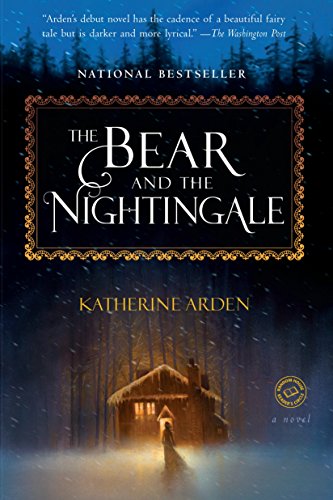
Fantasy - The Bear and the Nightingale
Summary:
- Deep in the wilderness of early Russia, Vasilisa Petrovna is the youngest daughter, cared for by her father, four older siblings, and kind old nurse. Vasya's mother died in childbirth, but the rumors surrounding her heritage point to her being the daughter of a witch. Vasya finds that, like her grandmother, she too possesses an ability for things unseen. She is the only one that can see and speak to the spirits of the house, stable, and forest, though everyone else considers them to be just stories. Dunya, Vasya's nurse, spins tales not only of household spirits, but also of the great frost king, who preys on young girls. Vasya's world is shattered when her father decides to remarry, finding a wife in the royal courts of Moscow who is a devout Catholic. Vasya's new stepmother, Anna, can also see the spirits, but considers them evil demons to be feared. She forbids the worship of the spirits, sending the village into chaos as evil begins to descend upon it. Only Vasya can use her abilities to save her people.
Fantasy Characteristics:
- We are deeply immersed into a descriptive world where magic is real.
- The story features good versus evil as Vasya is set up to battle several evil forces.
- Characters attain magical gifts- for Vasya, this is first in the form of a pendant, but other abilities are hinted at later on.
- The book has a slow start- Vasya is not even born at the beginning, and we bear witness to several pieces of her childhood to set the scene.
- The sequel to this book continues the story.
- Vasya embarks on a quest.
Read-a-Likes:
- Uprooted by Naomi Novik
- A Discovery of Witches by Deborah Harkness
- Shadow and Bone by Leigh Bardugo
Reader's Opinion:
- I love stories based on folklore and fairy tales, so the culture of this book was exceptionally beautiful to me. I am unfamiliar with Russian myths and enjoyed finding out more. Vasya is a likable character who balances her intelligence with wit and boldness. The book did lose me a little near the end when the pacing abruptly changed and a romance that didn't make sense was hinted at. I may consider reading the rest of the trilogy, but it's not a priority.
Wednesday, March 7, 2018
Week Nine - Book Club Experience
Books on Tap
I attended Books on Tap at The General Cafe. My library holds this event once a month and chooses an off-site location to promote a local business, have food and drink available without needing to provide it ourselves, and simply for the atmosphere. Having a discussion in a place other than the library also makes it more open to the community and is more inviting, especially if someone stumbles upon it while they're just stopping by for a drink. Overall, I had a good experience and might consider attending again! There were ten adults in attendance, which actually seemed like almost too large of a group. We may have benefited from splitting into two smaller groups.
A huge benefit of this loose structure was that there was a possibility for any book to be brought in for discussion. If someone is excited about a book, they'll sell its best points. Goldstein states that book clubs are, "organized loosely by their shared need for information about the books they are reading and for suggestions on what to read next." I saw quite a few participants writing down titles to read.
- Who is asking the questions, is there a leader or do people take turns?
- Rather than asking questions initially, participants are invited in turn to share what they're reading. Everyone brings a book, or two, or seven- no one book is read by all. After a participant describes a book they're reading, anyone else is invited to ask questions, though the leader of the program tended to step in during any lulls in conversation.
- If there is a leader, does the leader answer the questions as well or let the attendees respond first?
- The leader was more of a person to move things forward at the right time.
- What type of questions are asked? Any involving just yes or no answers?
- Questions asked were about opinions and what the reader thought about certain things, or what they agreed or disagreed with. For instance, when someone mentioned reading "A Wrinkle in Time," they commented how they didn't actually enjoy it as much as they expected to. Another participant asked why that was. After the explanation was given, other attendees shared their comments as well. This book club was more of a discussion than an exchange of questions.
- Do all attendees actively participate?
- Every attendee shared at least one book, and for the most part, people wanted to be part of the discussion. There were a couple of people on the quieter end of things who spent more time discussing their own book than commenting on others, but no one was completely passive.
- Do any attendees swoop in and steal all the spotlight?
- One person had read quite a few books in the past month, so the leader did gracefully cut him off to move on to someone else.
- What is the atmosphere of the discussion, where is it taking place at?
- The General is a cafe on the opposite side of the river from the major downtown section of South Bend, so it has a cozy, modern vibe. We are allowed to have the book discussion in the main room rather than an adjacent room that is usually used for events. Food and drinks are readily available, so it has a relaxed air about it- you can discuss a book while you kick back with a glass of wine or beer if you like. There is also coffee and a variety of coffee-based drinks, or an entire meal, which some people opted for. The atmosphere was welcoming and gave off a vibe of being flexible to whoever came for that month's discussion.
- Are snacks or drinks provided?
- The library does not provide any, but participants are welcome to purchase their own.
- What types of books does this book club normally discuss?
- There was a huge variety! The majority were adult fiction of various genres, but there was one person who brought some children's fiction along as well. A few readers, more than I expected, brought graphic novels along. There is no theme or required reading, everyone can bring whatever they happen to be reading that month.
Goldstein, Bill. “Reads Well with Others.” PublishersWeekly.com, 23 May 2005, www.publishersweekly.com/pw/print/20050523/21559-reads-well-with-others.html.
Friday, March 2, 2018
Week Eight
For my special topics paper, I chose to compare how a librarian might perform a youth reader's advisory interview versus an adult reader's advisory interview. As a Youth Services Assistant, I am usually helping children or parents rather than adults, so some of the information in my paper was from my personal experience. To my surprise, not a ton of articles were out there about specifically youth RA, but the ones I found were very thorough and helpful.
Much of youth RA is similar to that of adults. Librarians still have plenty of tools, like bestseller lists and Novelist, and some questions will be the same. You can still ask children about books they've read and liked, what they liked best about those books, and what they're hoping to read next. You must stay just as engaged- if anything, even more so, since some children will be nervous to approach a librarian. Being welcoming and helpful is still just as important.
However, there are some additional challenges in youth RA. Sometimes, children are interested in one thing, but have to read something else for an assignment, and it can be difficult to find a good balance between the two demands. Parents will also come in alone and ask for books for their child- they may or may not have an accurate idea of what their child wants to read. Children also may take some time to learn appeal terms and how genres work, so they may not be able to accurately tell you what they are looking for.
Overall, there aren't a lot of differences, but there are a few additional roadblocks that librarians who don't normally work with youth should be prepared for.
Thursday, February 22, 2018
Week Seven
Raise your hand if you've been personally victimized by James Patterson.
 I started my library career as a shelver, and was often frustrated by the shelf space that bestselling authors took up. But, during my time in my library's cataloging department, author mills were the absolute worst to me. I was the main fiction cataloger, so the handling and distribution of these items was often my responsibility. Being in a large system, this meant that we could have an order of somewhere between 80 to 140 copies of a book, and they all had to go somewhere.
Sometimes, we would get a book in a week or two ahead of time- great! Lots of time to process it and get all the copies linked into the system. Uh-oh- those 80 copies are going to take up LOTS of shelf space until it's time for them to go out... bummer. On the flipside, we would occasionally get a book, due out on a Tuesday, at 4:00 pm on Monday, prompting the entire department to drop whatever they might be doing and rush to help link all the copies, trap holds, and get the books in the right boxes, and still punch out on time. Author mills inevitably would put a huge strain on library staff in one way or another.
When I began working in other areas of the library and emerged from the cataloging bubble, I began to notice where these books ended up. Initially, the demand for the books was huge. We couldn't keep them on the shelf. Either there was another hold to fill, or it would be on display for no more than an hour before being checked out. Gradually, after a month or so, we could keep a few copies on display. A few were never returned, or returned damaged and in need of withdrawal. But eventually, you'd find twenty copies on the shelf, waiting to be weeded later on. The majority of author mill books are, in my observation, decently sized novels. When purchased new, all were hard cover. They still were taking up a LOT of space that could be used for other materials.
These books are the most popular, initially - they typically make headlines, topping the NYT Best Sellers for weeks at a time. Yet, when looked at for a longer term, they are an annoyance for staff on many levels. In this scenario, I think e-copies would be a huge benefit to save shelf space to have a bigger variety in a fiction collection, if patrons are willing to read in a new way.
Sunday, February 18, 2018
Week Six
In order to promote new horror reads at the library, we could have an interactive display and a program. Three popular horror movies based on books would be selected, with three corresponding jars. Patrons would be able to vote on which movie would be shown at the library in an after-hours lock-in by placing a ticket in the jar. The event would be limited to adults 21 and older, with a cash bar available to get extra revenue for the library. Raffle prizes would be made available. This event would appeal to many young adults seeking a new experience with the library.
The initial display would include a variety of horror novels. Patrons who have fun with voting at the display are more likely to take a look at the nearby books and consider checking them out. Once the movie had been chosen, the library could also purchase additional copies of the novel the movie is based on to encourage comparison between the two types of media.
The initial display would include a variety of horror novels. Patrons who have fun with voting at the display are more likely to take a look at the nearby books and consider checking them out. Once the movie had been chosen, the library could also purchase additional copies of the novel the movie is based on to encourage comparison between the two types of media.
Subscribe to:
Posts (Atom)